
Knowledge Base: Lambda Sensors
Here you will find technical information all about lambda sensors.
What Are Oxygen and Lambda Values Used For?
Why Do Oxygen and Lambda Values Matter So Much?
Oxygen Value
A lambda sensor can measure the oxygen content in almost any gas:
- Flue and exhaust gases from combustion processes (stationary combustion systems using any type of fuel, engines in CHP plants)
- In inert gases such as argon or nitrogen, e.g., for quality control
- In steam atmospheres, to determine the water vapor content
The lambda sensor is ideally suited for applications in hot gases, as both its measuring principle and its design are tailored specifically for this purpose. The wideband lambda sensor was originally developed for closed-loop control of internal combustion engines.
However, the sensor is by no means limited to this application. As long as no liquid water can form at the measuring point, the sensor is suitable for all temperatures.
Lambda Value
The lambda value is a parameter used primarily in internal combustion engines.
A modern engine with a three-way catalytic converter normally runs at a lambda value of 1, which corresponds to an air-fuel ratio (AFR) of 14.7. This means one part gasoline to 14.7 parts air (by mass: 14.7 grams of air for every 1 gram of fuel). This ratio is essential for the catalytic converter to work properly and to keep harmful emissions (CO, NOx, and unburned hydrocarbons) released into the environment to a minimum.
However, the optimal lambda value for maximum power is not 1, but 0.9. An engine runs most efficiently at lambda = 1.1.
Internal combustion engines in CHP plants are often operated with excess air in order to achieve the highest possible efficiency.
Construction of the Narrowband Lambda Sensor
Fundamentals of the Narrowband Lambda Sensor
Although almost everything here revolves around the wideband lambda sensor, a basic understanding of the narrowband sensor is essential to understanding how the wideband version works.
Narrowband lambda sensors consist of a ceramic sensing element printed with platinum electrodes. Almost all modern narrowband sensors also have a built-in heater that quickly brings the sensor up to its operating temperature of 700–800 °C.
The ceramic sensing elements come in either a finger-type (thimble) or a planar design:
The first lambda sensors were almost exclusively of the finger type. The sensing element is hollow, allowing a heating element to be inserted inside it.
The advantage of the planar sensing element is its heater embedded directly in the ceramic, combined with a lower thermal mass. This allows the sensor to reach its operating temperature more quickly.
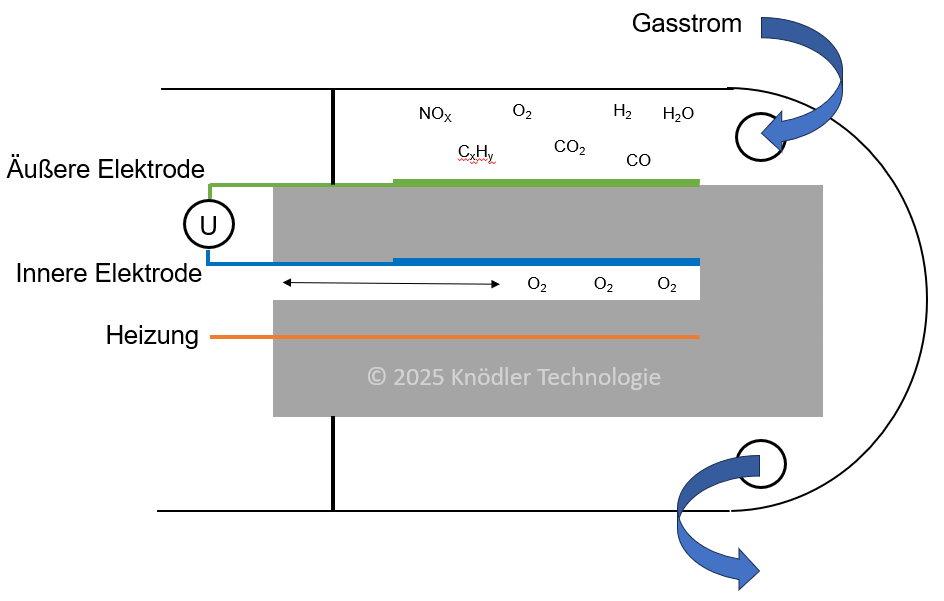
Narrowband lambda sensors output a voltage known as the Nernst voltage. This voltage depends on the difference in oxygen partial pressure between the reference gas (ambient air or oxygen) and the sample gas (exhaust gas).
This voltage is measured between the outer platinum electrode (exposed to the sample gas) and the inner electrode (exposed to the reference gas, i.e., air or oxygen):
The characteristic curve of narrowband lambda sensors is very steep at the transition from excess oxygen (oxidizing atmosphere at the outer electrode) to oxygen deficiency (reducing atmosphere at the outer electrode): the voltage rises abruptly in a sharp step. This step-shaped curve is why these sensors are also known as switching-type lambda sensors.
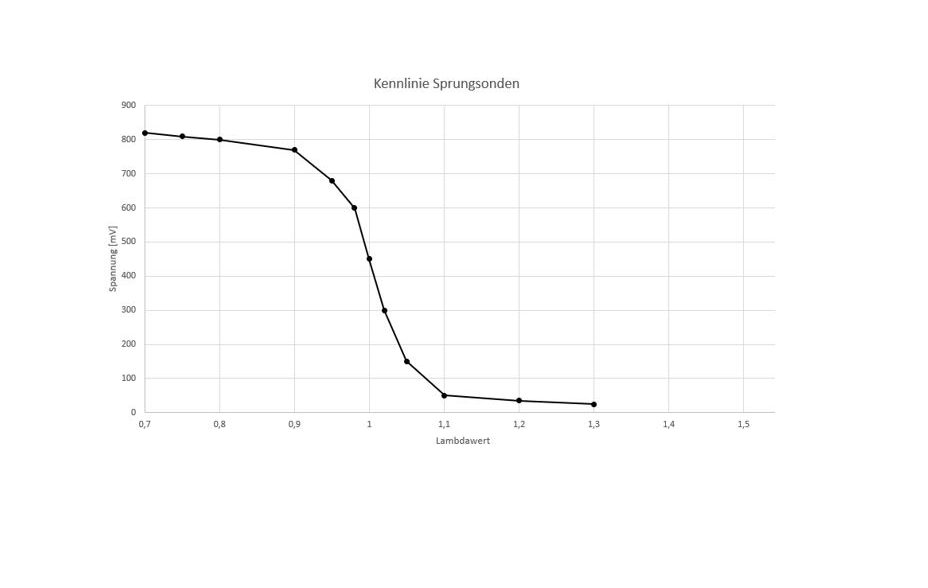
Outside the region around λ = 1, the characteristic curve has only a very slight slope. This slope is greater in the λ 1 range.
In general, the characteristic curve is strongly influenced by the temperature of the sensing element. In the λ < 1 range, the chemical composition of the sample gas also has a significant effect.
At 2% oxygen, the sensor's output voltage is only about 30–50 mV; at 21% oxygen, it is approximately −10 mV.
To improve accuracy, the latest narrowband lambda sensors use two techniques borrowed from wideband sensor technology:
- Measuring the internal resistance to determine the temperature of the sensing element
- Using a pumped reference to reduce environmental influences
Construction of the Wideband Lambda Sensor
Fundamentals of the Wideband Lambda Sensor
The wideband lambda sensor has a lot in common with the narrowband lambda sensor:
- Externally, the housing looks very similar
- The material (the ceramic used) is the same, and the operating principle is at least partially identical
- Both sensor types are usually heated, with the temperature controlled via the internal resistance
Unlike the narrowband sensor, however, the wideband sensor uses two “cells”: the pump cell and the Nernst cell.
Choosing the Right Sensor Type: Key Differences
Sensor Types and How They Differ
Lambda sensors are available from various manufacturers in a wide range of versions. The largest manufacturers are Bosch, Niterra (NTK/NGK), and Denso.
Here, we focus on the different sensor types offered by Bosch:
- Bosch LSU 4.2
- Bosch LSU 4.9
- Bosch LSU 5.1
- Bosch LSU 5.2
- Bosch LSU 6
Bosch LSM 11 Alternatives and Replacements
Sensor Types and How They Differ
The Bosch LSM 11 is technically a narrowband lambda sensor. However, it was designed to also deliver a linear output signal in oxygen-rich gases.
As with all narrowband sensors, however, the output signal has only a very small voltage swing, ranging from approximately −10 mV in ambient air to 40 mV at 2% oxygen.
In addition, this signal is highly dependent on temperature and sensor aging.
The Bosch LSM 11 was discontinued in 2022 and is no longer in production. Remaining stock is virtually exhausted.
To keep older controllers in operation, two alternative sensors have emerged as the preferred options:
- Niterra (NGK/NTK) OZA685
- Bosch LSF 4.2
Both sensors differ from the Bosch LSM 11 in some respects, but are compatible in most cases.
For details, please refer to our technical report: Link
The Bosch LSF 4.2 uses a planar sensing element, while the Niterra (NGK/NTK) OZA 685 features a finger-type element.
The original LSM 11 sensor had a finger-type sensing element.